What is GAF Master Elite?
Learn what a GAF Master Elite credential can indicate, how to verify it, and why current warranty terms and written scope details matter...

Table of Contents
- What GAF Master Elite Means—and What It Does Not
- Verify a Contractor’s Current Certification Before Signing
- Separate Manufacturer Certification From Contractor Quality
- Read Warranty Eligibility Before Comparing Coverage
- Compare Warranty Tiers From Current Terms
- Use a Written Roof-System Scope to Apply the Credential
- Ask the Questions That Turn a Badge Into a Decision
GAF Master Elite is a manufacturer credential for qualifying roofing contractors. It can be relevant when a homeowner is comparing a GAF roof system and the enhanced warranties that may be available through certain contractors. It is not a universal guarantee of workmanship, a substitute for reviewing the proposal, or a promise that every GAF product or warranty is available for every roof.
The legacy articles correctly treated the credential as a reason to ask better questions. They also contained historic percentages, ratings, insurance figures, product descriptions, and warranty details that should not be repeated as current facts. This consolidated guide keeps the useful decision process and directs the homeowner to current manufacturer documents before a contract is signed.
A credential is most useful when it leads to an accountable scope: the contractor’s current status can be verified, the proposed roof system is named, the warranty conditions are understood, and the homeowner knows what is and is not included.
What GAF Master Elite Means—and What It Does Not
At its core, the designation identifies a contractor who participates in GAF’s contractor program at the Master Elite level. That can matter because some GAF enhanced warranties have contractor-status requirements. It does not tell you, on its own, whether a particular contractor is currently eligible, whether the proposed products satisfy a warranty’s system requirements, or whether the final installation will meet every condition in the applicable documents.
Think of it as one verification point, not a shortcut around the rest of your due diligence. The roof still needs an accurate diagnosis, a clear scope, appropriate detailing, documented materials, qualified installation, and a way to resolve questions if conditions change during the work.
Certification Is Not a Universal Guarantee
No certification replaces a homeowner’s review of the agreement. Do not treat a badge, a logo, an old article, or a sales statement as proof of a final warranty, a particular service outcome, or a contractor’s current status. Ask the contractor to identify the credential they hold today and which, if any, enhanced warranty they are proposing for your exact roof system.
That distinction protects both sides. It gives the contractor a chance to explain the actual proposal and gives the homeowner a record that can be compared with the manufacturer’s current terms.
Verify a Contractor’s Current Certification Before Signing
Ask the contractor for the exact business name under which the work will be performed, then confirm the current designation through the official GAF contractor directory. Verify the business identity rather than assuming that a similar company name, an old advertisement, or a logo on a vehicle establishes present status. If you have questions, ask the contractor and GAF to clarify the current information before relying on it.
Affordable Roofing Systems also maintains information about its GAF-certified roofers. That page can help start a local conversation, but the manufacturer directory and the final written proposal remain the right places to verify a current designation and the specifics of a proposed system.
This verification step is especially important when an older article uses a location-focused search phrase or gives a numerical claim about the program. Geographic marketing language and historic program statistics do not determine the credential that applies to a new project.
Separate Manufacturer Certification From Contractor Quality
Manufacturer participation is one useful signal, but it does not eliminate the ordinary questions of hiring a roofing contractor. Verify the business identity, applicable license and insurance information, references for comparable work, written scope, communication process, payment terms, and how changes will be documented. Those checks are independent of any single manufacturer program.
The older source articles emphasized company history, distributor relationships, ratings, and broad statements about quality. Those facts can become stale or may not apply to the exact business and project in front of you. A more durable approach is to ask for current, project-specific documentation instead of relying on a historic generalization.
A contractor who is comfortable with scrutiny should be able to explain what they observed, why the scope addresses it, which materials are included, and where the homeowner can independently verify the key claims.
What to Verify in the Proposal
The proposal should identify the selected GAF products and the system components being installed, not just use a general manufacturer name. It should describe removal or repair assumptions, transitions and flashing where applicable, ventilation work when part of the design, property protection, cleanup, permit-related responsibilities, and the process for approving a newly discovered condition.
If an enhanced warranty is part of the discussion, ask for its exact name and the current documents governing it. Make sure the proposal explains whether registration, inspection, accessory products, or other eligibility conditions are involved. Do not infer those details from a warranty tier name alone.
Read Warranty Eligibility Before Comparing Coverage
Warranty names can make a comparison feel simpler than it is. Coverage, exclusions, registration, transfer terms, workmanship provisions, inspection requirements, and system-product conditions can differ. A warranty also does not replace maintenance, inspection after a concerning event, or a careful review of the roof condition before work begins.
Use the manufacturer’s current GAF warranty resources to identify the governing information for the proposed product. Then compare it with the written scope, the contractor’s current status, and the documents they will provide at completion. When a term is unclear, get a written explanation from the contractor or manufacturer rather than relying on a verbal summary.
Compare Warranty Tiers From Current Terms
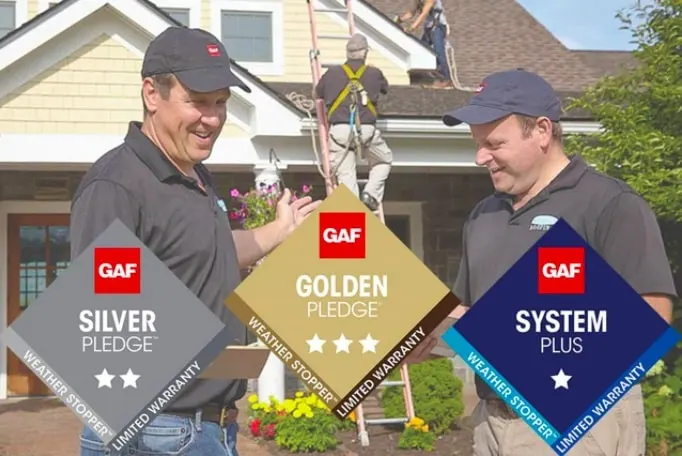
The legacy pages named Golden Pledge, Silver Pledge, and System Plus warranties. Those names are useful starting points, but their eligibility and coverage cannot be safely summarized from an archived article. GAF’s own materials can change and may set different contractor-level and roof-system requirements for each option.
Review the current residential warranty guide alongside the exact warranty document proposed for your project. Ask the contractor to state which warranty is being offered, what installed materials and steps are required, which party handles registration, and which version of the terms governs the work.
If two proposals mention different warranty levels, compare the complete roof systems and scopes—not just the tier names. A better match for the home may depend on the roof condition, selected materials, budget, and the documented requirements, not the strongest-sounding marketing phrase.
Use a Written Roof-System Scope to Apply the Credential
A credential becomes meaningful when it is connected to the actual work. The written scope should show what roof condition was observed, what work is proposed, which materials and system components will be installed, what is assumed about hidden conditions, and how a change will be approved. This is where a homeowner can see whether the manufacturer discussion matches the project rather than floating above it.
Compare proposals line by line. A lower price may describe a different amount of removal, a different material, or fewer system details. A higher price is not automatically a better scope. Ask each contractor to explain the differences and give you documents you can review away from the sales conversation.
If a roof has an active leak or a safety concern, urgent temporary protection may be appropriate. That still does not require a homeowner to skip verification or accept a broad permanent scope before the facts and documents are clear.
Ask the Questions That Turn a Badge Into a Decision
Before authorizing work, ask: Is this business currently listed at the stated GAF credential level? Which exact products and system components are proposed? Which warranty, if any, is being offered? What current document controls its terms? Who handles registration? What assumptions are in the price? How will deck repairs or other discovered conditions be documented and approved?
Good answers are specific, written where they need to be, and consistent with the manufacturer’s information. If an answer relies on pressure, vague statements, or a promise that cannot be shown in the current documents, pause and verify before you commit.
That is the enduring value of the GAF Master Elite conversation: not a reason to stop asking questions, but a reason to ask them with a clearer record in front of you.
Considering a GAF roof system?
Discuss a GAF Roofing Scope
Request a free roofing estimate from Affordable Roofing Systems to review the roof condition, proposed materials, written scope, and questions you want answered before making a final decision.
Schedule a free roofing estimate